What Fitness Equipment You Need for a Full Body Workout?
>> Sep 10, 2015
Various articles on family topic
Children adore playing and they can’t seem to get enough of it. That would be just fine, if it wasn’t for unintentional injuries putting parent’s nerves on edge. Outdoors is full of potential dangers, but many people overlook the biggest threat to children’s safety - your home. Fire, drowning, choking, poisoning and falls are your primary concern here, and prevention is the best cure there is. It’s high time to take the home safety measures before trouble knocks on your door.
Toy Story
Children like to explore and look for hidden treasure, but sometimes that treasure is cursed and can harm them. It’s thus a good idea to scope out the surroundings from your child’s point of view. If you have a crawling little fellow, it’s time to get down on your knees and scout the area. See what items are in reach, and keep a close eye on those tiny ones that could lead to choking.
Bear in mind also that our homes are full of items that could be poisonous to children. Put them out of reach and store them well. You can use safety latches on all your drawers and cabinets to avoid any risk. No worst case scenario is improbable enough to ignore the potential hazard it could cause.
Traps and treachery
Try to keep your kids away from the kitchen and bathroom with the help of gadgets like doorknob covers. As an alternative, you can check out the safety gates that limit the access to such perilous places. In any case, don’t leave your windows open, as cartoons are not giving children the best idea about the physics of a free fall.
Pay special attention to water areas, however small they might be. Children can drown in just a few inches of water, and toilets with open lids can prove to be fatal. The garden is another place that is full of traps, and children spending a lot of time outdoors during summer should be protected with shade sails or sunshades.
Electricity is essential for all modern homes, but it can be a treacherous thing. Once as a kid it seemed to me like a good idea to put mixer beaters into an electrical outlet. The result was anything but pleasant. To prevent situations like these, cover all unused outlets with protectors and safety caps, and exposed outlets with electrical tape.
In the end, don’t forget that no amount of gadgets is a substitute for your eyes and ears. Supervise your children whenever possible, and don’t get the false sense of security because you purchased expensive products. As your child grows, and learns to walk and climb, be ready to adjust your safety measures.
Safe and sound
If your home is to be a safe environment for children, you first need to identify potential hazards. Some areas are more dangerous than others, so keep the little ones away from there. Childproof your whole home and always be on the safe side. There are a lot of home safety gadgets that can help in your efforts, but the best thing to do is to always keep an eye on your kids. Stay alert and be prepared for both emergencies and everyday risks.
The creative adult is the child who survived, and if you want to make sure that your kid grows up to be just like that, you will have to spend a lot of time playing and having fun. Though, make sure that you pick out entertaining and amusing things to do, otherwise your kid might feel like it is a chore, and it could quickly becoming boring.
Make something together
Kids love nothing more than to explore their surroundings and to find out what is what in this world. If you manage to pick out a DIY project you guys can do together, it will be great. Not only will you be able to have fun, but, you will also spend some quality time together. Do not forget that it is a valuable moment to use for teaching something new, and, who knows, you might even learn a thing or two.
Go on a treasure hunt
Following a treasure map is always fun, especially when it has a big red X on it somewhere. Just make sure that it is easy to find the hidden treasure. The possibilities for an alternative treasure hunt are endless, and you can easily combine various elements from other games as well. Your imagination will be your only hindrance, but, make sure that the clues are easily deciphered, as kids cannot follow adult logic all the time.
Pretend to be a pirate
Yar! Pretending to be a pirate can be a lot of fun, and even more so if you manage to build a fort or a ship. Do not forget the loot you will have to burry somewhere, and a map, because no pirate is complete without a map they can follow back to their treasure. Of course, you will be the captain, and you will have the duty to train junior pirates. If you are clever, you can sneak into a few chores as well.
Cooking up something tasty
Teaching your children a valuable lesson in life does not always have to be in a form of a lecture. You can enjoy baking something with your kids, and, if they become really good at it, they might even take the next step towards creating something more amazing. Nevertheless, a simple baking project can never hurt, and it will allow for some time to be spent together. Furthermore, down the road, it is also possible that your kids can teach you how to add more flavor.
Letting out some steam
Fighting is never the answer, unless you are doing it in a sumo suit! This getup will enable for some harmless fun, and a way to secretly let out some pressure. Moreover, it will give your kids a chance to try and tackle you, without any repercussions, but only within the limits of the game. Expanding the game if you have a big enough family, or inviting friends over, can turn it into a tournament, making it even more fun for everyone participating.
Let your children choose something too
Some games will be more likeable by a parent, which is understandable, but, you should let your kid choose once in a while as well. You will give them an opportunity to be equal, so that they can feel important as well. Though, always have a list of games and activities you can do together, so that they can have a choice in it, and that you do not have trouble coming up with new ones. Though, make sure that you have the necessary materials for your next fun session.
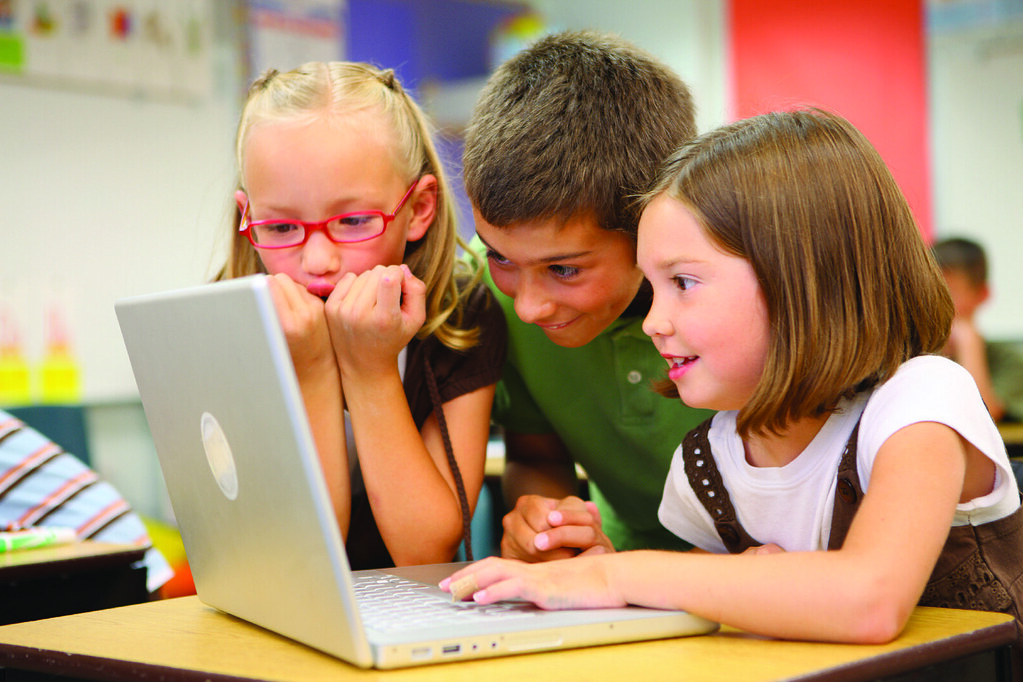
Computers are increasingly becoming a mandatory part every household and the children are exposed to them from their earliest days. Parents are faced with the questions like what is the right age to introduce computers to their children, what are the advantages and disadvantages of computer use and what possible health problems this may cause. By looking at their parents using computers, kids would probably want to do the same.

It is not recommended for a child under 2 years of age to use a computer, or be exposed to any screen for that matter (television, consoles…) because the eye muscles are not fully developed yet. Luckily, children themselves show real interest in the computers between the age of 3 and 6. In this period, parents should gradually introduce different kinds of games that are appropriate for the age and interest of the child. Keep in mind that the development and interests of children vary on an individual basis, and while some children may show an interest earlier, others may not be interested in computers for a long time. If your child doesn’t show an interest in computers, don’t impose it on them. There is plenty of time to learn everything there is to know, when they’re older.
Between 6 and 9 years of age is when most children are already familiar with the computer. If you didn’t have a computer in your house it is possible that this is when you would probably get one at the request of your child. If this is the case, do not put the computer in child’s room, but somewhere visible to you, in order to have a better idea of the amount of time your child spends playing on the computer. Teach your child that a computer is not just for playing games - this is the age when a child can get numerous educational multimedia content that can greatly expand his or her knowledge, especially when it comes to school subjects.
Provide your child with good computer chair because the back has to be straight. Correct posture is very important for the development and healthy growth. The appropriate distance from the child’s face to the screen should be between 45 and 70 cm. The environment must always be well lit, but check that no source of light (natural or artificial) is reflected on the screen.
When they get older, most children will already use a computer better than their parents. Internet and social networks will probably become standard means of communication of your children and their friends. During this period it should be paid special attention to teaching your child what Internet safety is and how to behave online. You can always protect your child from unwanted content and contact with parental control systems which have time slots you can easily set up. Moreover, most search engines have filtering options that can prevent unsuitable content for children from appearing.
When your children hit puberty, you should expect them wanting PCs or laptops of their own. Most children are addicted to gaming and social networks in this period and they would like to have their privacy. Gaming laptops or better performance PCs are some of the things that may be on their wish-list. As long as you took your time explaining your child that there is time to play and time to study, there shouldn’t be a lot of problems in this regard.
Numerous studies on the effect of computers on the intellectual, physical and social development are being done around the world, but the results are still insufficient to draw any final conclusions. A positive link between use of computer and cognitive development of preschool children from the age of 5 and up was found, but additional research is needed to determine the impact on very young children who are in the period of intensive development and acquisition of first knowledge about the world and environment. Only after years of study it will be possible to give definitive recommendations on the use of computers in the early years and its positive and negative aspects – until then, trust your judgement as a parent, respect your children’s interests and try to present proven content, appropriate for their age.
Every school has some form of traditional rules imposed on teachers and on students as well. However, with new technologies emerging ever so frequently, there is a big shift in how students and teachers behave among and towards each other. Though, it is expected that schools will undergo changes as well, the question is whether it will have a positive or negative influence.

A chance to increase student engagement
With introducing technologies in the classrooms, it is possible that students can become more active, not only in class, but also outside of it. Effectively making students become more self-sufficient and to be able to research on their own. However, it will also offer teachers new methods of teaching and passing on knowledge. On the other hand, communication between teachers and students should improve as well.
Use what you have
Classrooms will have the possibility to enable students to connect even via personal smartphones, making classes seem more interesting. Moreover, by introducing mobile learning, students will be able to follow classes even if they are from another part of the world. Moreover, students and teachers will be able to exchange information and get questions answered without having to disrupt the class. Remember to teach your students about mobile etiquette and what acceptable behavior is, so that they do not abuse their phones in class.
Introducing interactive learning
Keep in mind that as technology evolves, interactive learning will get a new perspective and dimension as well. The question then will be whether teachers and students are capable to undergo the necessary changes. Teachers should gradually introduce new interactive methods used in the classroom, so that students can get accustomed. Furthermore, it will provide a new horizon for being able to learn more, and to make learning more fun and interesting.
Accepting the new changes
Schools should have proper equipment
The most important consideration for enabling better relations between teachers and students will be the necessary equipment required for schools. Though it might seem that it is impossible to get everything that a modern school would need, it is in fact possible to existing infrastructure and modify it according to the school’s needs. On the other hand, if the substructure is developed gradually, it will leave room for further improvements in the future.
Related article:School Tables -Shapes,Heights and Sizes
Handling school needs
As schools become more modern, and more equipped with new gadgets and computers, it will become pricier to get in as well. Though, with school easy pay, it will be possible to handle books, fees, and even other school required activities, with a few easy payments. On the other hand, make sure that you plan your budget so that you have enough to cover tuitions and required gadgets to follow the program without any problems.
The future of technological advancements in the classroom
Although it is not definite what will happen, one thing is certain. Without a teacher to conduct a class, it will be hard to imagine education. Even if there are technological advancements in schools, a teacher-student relation must be established in order to pass on knowledge and to really teach something.
Schools should not oppose changes, rather, try to give teachers time and resources to work these new advancements into their classes. After all, a teacher is best if they can teach in an environment they understand and feel welcome in. Moreover, students feel safe with teachers they trust and can ask question related to schools and otherwise. In the end, remember that there is always a test period where you will be able to see if schools are ready for changes.
© Free Blogger Templates Autumn Leaves by Ourblogtemplates.com 2008
Back to TOP